
Forklift Aisle Width and Pallet Racking in Indianapolis Warehouses
9 min read · May 2026 · Indy Pallet Racking Team
Aisle width is the single most important variable in warehouse storage density — and one of the most misunderstood. Get it wrong and you either waste thousands of square feet of floor space or you put your forklift operators and racking at risk. This guide walks Indianapolis and Central Indiana warehouse operators through the practical aisle width decisions that determine how many pallets you can store and how efficiently you can move them.
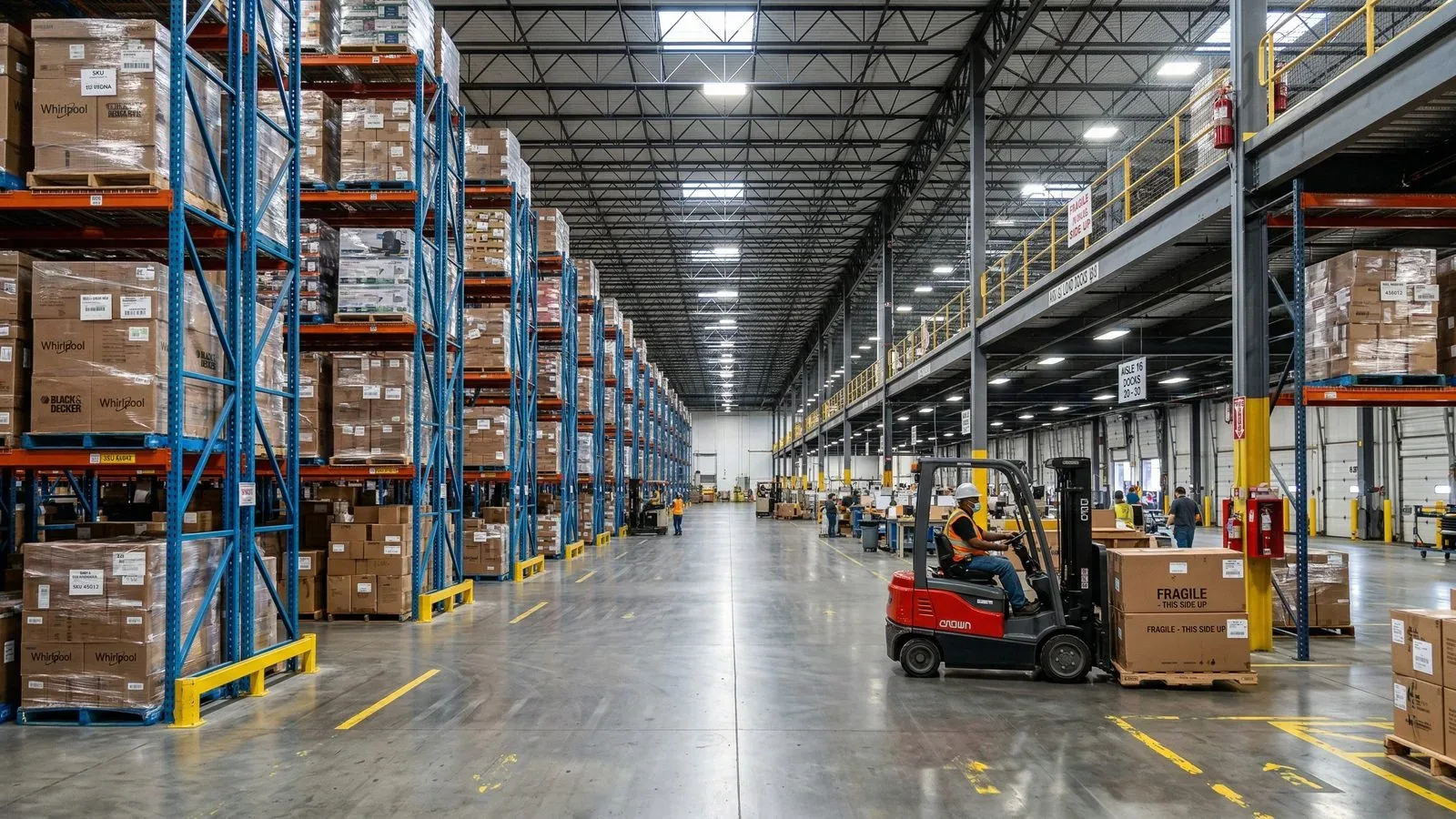
The Three Aisle Width Categories
Every warehouse layout decision starts with choosing which aisle width category your operation will use. Each category involves a trade-off between storage density and equipment cost:
Wide Aisle (10–12 ft)
Uses counterbalanced forklifts. Lowest equipment cost. Easiest to operate. Lowest storage density — typically 30–35% of floor space is aisles.
Narrow Aisle (8–10 ft)
Uses reach trucks or turret trucks. Higher equipment cost. 15–20% more storage positions than wide aisle in the same footprint.
Very Narrow Aisle (5–6 ft)
Uses wire-guided or rail-guided man-up trucks. Highest equipment cost. Maximum storage density — up to 40% more positions than wide aisle.
OSHA Aisle Width Requirements
Before you design for maximum density, you need to understand the regulatory minimums. OSHA 29 CFR 1910.22 establishes that aisles used by mechanical handling equipment must be:
- At least 3 feet wider than the widest vehicle or load passing through the aisle
- Clearly marked with permanent floor markings or other visual delineation
- Kept clear of obstructions at all times
OSHA 29 CFR 1910.178 (powered industrial trucks) adds requirements based on the specific truck type and load dimensions. For pedestrian aisles not used by powered equipment, the minimum is 28 inches.
In practice, OSHA's "3 feet wider than the load" rule means a standard 48-inch-wide pallet on a counterbalanced forklift requires a minimum 84-inch (7-foot) aisle just to meet OSHA minimums — and that's for one-way traffic. Most Indianapolis warehouse safety professionals recommend 10–12 feet for two-way counterbalanced forklift traffic.
Aisle Width by Forklift Type
The forklift type you operate — or plan to operate — directly determines your minimum functional aisle width. Here are the practical working aisle requirements for the most common equipment types used in Indianapolis warehouses:
Counterbalanced Forklift (Sit-Down)
The most common truck in Central Indiana warehouses. Requires the most aisle space because it must turn perpendicular to the rack face to place or retrieve a pallet. Working aisle requirement: 10.5–12 feet for a standard 48x40-inch pallet. These trucks are versatile, operate on any surface, and can be used outside — making them the default choice for operations that also need to work at dock doors or on uneven surfaces.
Stand-Up Reach Truck
Requires 8–9.5 feet of working aisle. The reach mechanism allows the forks to extend into the rack face without turning the truck body, significantly reducing required aisle width. Reach trucks are electric, work best on smooth concrete, and can reach beam heights of 30+ feet. They're the standard choice for high-density Indianapolis distribution center operations.
Turret Truck (Man-Up)
Requires only 5.5–6 feet of working aisle. The operator platform rises with the load, and the forks rotate 90 degrees to service rack on either side of the aisle without moving the truck. These trucks require a very flat, smooth concrete floor (typically F-number specifications) and are usually wire-guided or rail-guided in the rack aisles. They deliver the highest storage density of any forklift application.
Order Picker
Requires 6–8 feet of working aisle. The operator platform rises with the forks, allowing picking from upper beam levels directly into a pallet on the truck. Common in Indianapolis e-commerce fulfillment and break-bulk distribution operations.
Walkie Pallet Jack
Requires 8–9 feet. Used for ground-level operations only. Common in floor-level storage applications and cross-docking. Often used alongside counterbalanced forklifts in split-level operations.
How Aisle Width Affects Total Storage Capacity
Here's a concrete example for a typical Indianapolis mid-size warehouse — 50,000 sq ft, 25 feet clear height, 150-foot-deep floor plate:
- Wide aisle (12 ft) with counterbalanced forklifts: Approximately 1,800–2,200 pallet positions
- Narrow aisle (9 ft) with reach trucks: Approximately 2,400–2,900 pallet positions — a 30–35% increase
- Very narrow aisle (6 ft) with turret trucks: Approximately 3,000–3,600 pallet positions — a 60–70% increase over wide aisle
The trade-off: reach trucks cost $30,000–$50,000 per unit versus $20,000–$30,000 for a used counterbalanced truck. Turret trucks cost $60,000–$100,000+ and require a specialized concrete floor specification. The math usually favors narrow aisle for operations storing more than 1,500 pallets in leased space, where every saved square foot reduces rent cost.
Indianapolis Warehouse Considerations
Central Indiana's warehouse market has some specific characteristics that influence aisle width decisions:
- Column spacing: Most Indianapolis industrial buildings have 40x40-foot or 50x50-foot column grids. Aisle layouts must work around structural columns, which often forces certain aisle widths to accommodate column positions without losing rack rows.
- Dock configuration: Many Indianapolis warehouses were built for cross-dock operations with dock doors on both long walls. This creates traffic flow patterns where wide aisles along dock walls are beneficial even if rack aisles are narrow.
- Older building floor quality: Older industrial buildings in areas like the near east side, Plainfield, and Speedway sometimes have concrete floors that don't meet the flatness specifications required for very narrow aisle turret truck operations — adding remediation cost to the density equation.
- Building height: Many of the newer logistics parks in Plainfield, Whitestown, and Greenfield offer 36-foot clear heights, making narrow aisle reach truck operations even more attractive as they can fully utilize the vertical cube.
Getting Your Aisle Width Right From the Start
Aisle width decisions made at design time are difficult and expensive to change once rack is installed. The best approach is to model your specific warehouse with a professional layout before committing to a configuration. This means accounting for your actual forklift equipment, your pallet sizes, your product throughput patterns, and your building's specific column grid and dock positions.
Indy Pallet Racking provides professional warehouse design and space planning for operations throughout Indianapolis and Central Indiana. We'll model your specific building and operation to identify the aisle width strategy that maximizes your storage capacity within your equipment and budget parameters. Call us at (317) 597-6252 to discuss your project.
Already have a layout and need the racking installed? Visit our Indianapolis service area page to learn more about our installation services across Marion County and the surrounding region.
Maximize Your Indianapolis Warehouse Storage
We design and install racking systems for Indianapolis warehouses of every size. Free layout consultation and detailed storage capacity analysis included with every estimate.
Get a Free Layout ConsultationReady to Optimize Your Warehouse?
Get a free estimate from Indianapolis's warehouse racking experts. We serve warehouses of all sizes throughout the Indianapolis, IN metro area.