Drive-In Pallet Rack Systems in Indianapolis, IN
Quality drive-in pallet rack supplied and installed by Indianapolis's trusted warehouse solutions team.
Ready to get started? Get a free, no-obligation quote today.
Maximum-density LIFO storage — forklift drives into the rack, pallets rest on continuous side rails, 2 to 10+ deep.
About Drive-In Pallet Rack
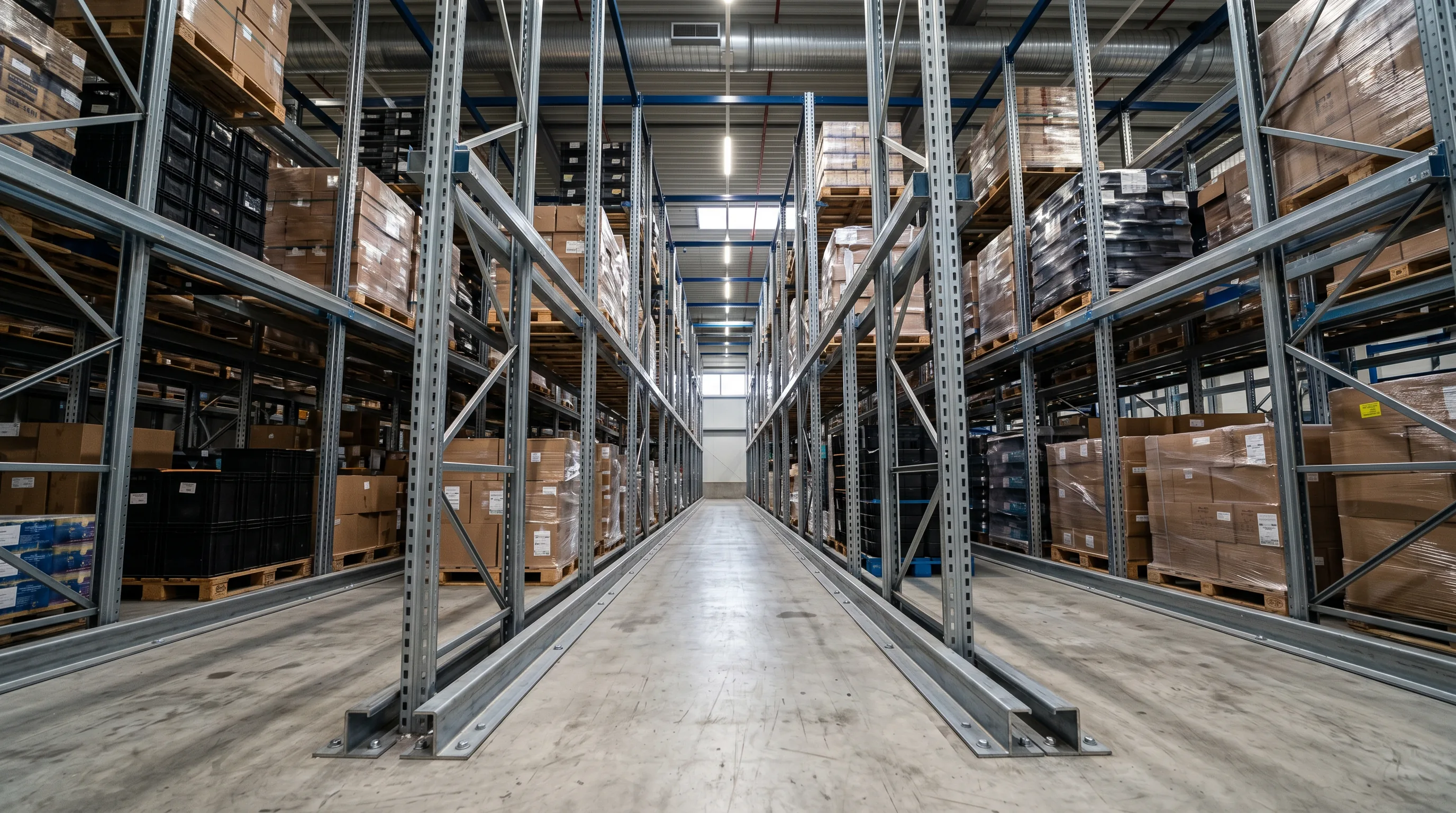
Drive-in pallet rack is the highest-density pallet storage system outside of full automation. The forklift drives into the rack structure between heavy structural columns, traveling on floor-level wheel paths, and places pallets on continuous side rails that run the full depth of the lane. Pallets are stored 2 to 10+ deep, stacked 3 to 5 high, with every cubic foot inside the rack footprint converted to storage. The tradeoff is real — drive-in runs LIFO only, rack-damage exposure is the highest of any rack type because forklifts physically enter the structure, and every bay typically holds a single SKU. But for Indianapolis operators with homogeneous, bulk, lower-selectivity inventory — especially cold storage freezers along the I-70 and I-65 corridors, the automotive buffer-stock operations, and seasonal peak staging at the regional retail DCs — drive-in delivers the lowest capital cost per pallet position of any serious rack system. Indy Pallet Racking engineers drive-in installs for Indiana wind loads (ASCE 7, 110 mph 3-second gust typical) and anchors to IBC 2021 with Indiana amendments and RMI ANSI MH16.1-2023, with column-protector packages specified on every install to keep rack repair costs controllable over time.
How Drive-In Pallet Rack Works
The mechanics behind the system — and why they matter for your operation.
Heavy structural uprights
Vertical columns are set on a deep grid — wider than selective rack — and every load is transferred directly to these columns. There are no beams; uprights carry all vertical and lateral loads.
Continuous side rails
Instead of beams spanning front-to-back, drive-in uses horizontal side rails that run the full lane depth along the inside of each column line. Pallets rest on these rails at every level.
Forklift enters the rack
A lift truck drives directly into the lane, between column lines, to place or retrieve a pallet. Loading starts at the back of the lane and fills forward; retrieval picks from the front.
LIFO per lane
Because every pallet sits on the same continuous rail and loading and picking happen from the same aisle, the last pallet loaded is the first one picked. Drive-through configurations with opposing aisles enable limited FIFO where operationally justified.
When to Choose Drive-In Pallet Rack
- • You need maximum density and LIFO rotation is acceptable
- • A bay will hold a single SKU (or very few SKUs) at a time
- • Cold storage or freezer operations where cube utilization is the dominant cost lever
- • Seasonal or peak-period inventory staging where selectivity matters less than capacity
- • You already operate reach trucks or narrow-aisle fleet, or will invest to run them
When Not to Choose
- • You need FIFO — go with pallet flow instead
- • SKU count per bay is high — selective is the right call
- • Your operation cannot tolerate rack-damage repair cycles — consider pushback
- • Your forklift fleet is all counterbalance and you do not want to change that
Specifications at a Glance
- Lane depth
- 2 to 10+ pallets deep
- Pallet capacity
- Up to 2,500 lbs per position (rail-supported); structural options higher
- Rotation
- LIFO (drive-in); FIFO possible with drive-through
- Load support
- Continuous side rails running full lane depth (no beams)
- Upright construction
- Heavy structural steel — columns carry all load
- Forklift required
- Reach, narrow-aisle, or sit-down — enters rack structure
- Column protectors
- Standard on every install — non-negotiable for damage control
- Height configuration
- 3 to 5 pallets high typical; taller with engineering review
- Code compliance
- IBC 2021 (Indiana amendments), RMI ANSI MH16.1-2023
- Indianapolis seismic / wind
- SDC B, wind per ASCE 7 (110 mph 3-sec gust); lateral loading governs anchoring
Drive-In vs. Other High-Density Options
| Attribute | Selective | Pushback | Drive-In | Pallet Flow |
|---|---|---|---|---|
| SKU selectivity | 100% | Medium (per lane) | Low (per bay) | Low (per lane) |
| Rotation | Any (FIFO or LIFO) | LIFO | LIFO | FIFO (automatic) |
| Lane depth | 1 pallet | 2–6 pallets | 2–10+ pallets | 2–20 pallets |
| Forklift enters rack | No | No | Yes | No |
| Rack-damage exposure | Low | Low | High | Low |
| Density vs. selective | 1.0× | 1.8–2.0× | 2.0–2.5× | 2.5–3.0× |
| Forklift type needed | Standard | Standard | Reach / narrow-aisle | Standard |
| Relative cost per position | $ | $$ | $$$ | $$$$ |
Where Drive-In Pallet Rack Fits in the Indianapolis Metro
Specific industries across Indianapolis and Indiana where this system pays off.
Cold storage freezer — Plainfield, Whitestown, Mount Comfort
Americold Indianapolis, Lineage Logistics, and regional refrigerated 3PLs use drive-in for bulk homogeneous SKU freezer storage where every square foot of floor space costs significant refrigeration energy. Drive-in compresses footprint harder than pushback and pays back in utility bills within the first few years.
Tire & rubber distribution — Indianapolis, Greenfield, Mooresville
Regional distributors for Michelin, Goodyear, and major tire retailers run drive-in for identical-SKU bulk tire storage. A bay holding 40 identical passenger-car tire SKU cases is the textbook drive-in use case.
Paper & pulp — Richmond, Wabash, Terre Haute
International Paper (Richmond IN), WestRock, and paper roll distribution operations across the Indiana corridor use drive-in for bulk roll stock and corrugated bundles where SKUs are homogeneous and pick frequency per bay is low.
Automotive buffer stock — Greensburg, Lafayette, Columbus
Honda Manufacturing of Indiana (Greensburg), Subaru of Indiana Automotive (Lafayette), and Cummins (Columbus IN) use drive-in in peak-staging zones where a bay holds a single-SKU bulk outbound lot for defined dwell before shipping to the line.
Seasonal retailer DC — Plainfield, Whitestown, Greenwood
Home Depot Plainfield RDC, regional Lowe's operations, and retail seasonal staging use drive-in for peak-window SKUs — holiday product, patio furniture in spring, heating equipment in fall — where a SKU is in and out in a defined window and density beats selectivity.
Product Features
- Lane depths from 2 to 10+ pallets, heights typically 3–5 pallets high
- Heavy structural steel columns — all load transfers through uprights
- Continuous side rails running full lane depth (no beams to bow or fail)
- Column-protector packages standard on every Indianapolis installation
- Drive-through configurations engineered for limited-FIFO operations
- Compatible with reach, narrow-aisle, and sit-down forklift fleets
- Engineered to IBC 2021 (Indiana amendments) and RMI ANSI MH16.1-2023
Benefits for Your Business
Frequently Asked Questions
Real answers for buyers researching drive-in pallet rack in the Indianapolis metro area.
How is drive-in different from drive-through?
What kind of forklift do I need for drive-in?
Why is rack damage such a concern with drive-in?
How does drive-in compare to pushback?
What SKU mix makes drive-in the right answer?
Can drive-in be used in a freezer?
Related Services
We don't just supply — we design, install, inspect, and maintain.
Get a Free Quote
Contact us today for a no-obligation quote on drive-in pallet rack for your Indianapolis metro facility.
Request Free Quote (317) 597-6252Free, no-obligation quotes
Professional installation available
Licensed & fully insured
Serving all Indianapolis metro areas
Ready to Optimize Your Warehouse?
Get a free estimate from Indianapolis's warehouse racking experts. We serve warehouses of all sizes throughout the Indianapolis, IN metro area.