
Repair or Replace Damaged Pallet Racking? A Guide for Indianapolis Warehouses
10 min read · May 2026 · Indy Pallet Racking Team
A forklift clips an upright column. A beam gets knocked out of position. Product shifts and damages a cross-brace. These incidents happen in every active Indianapolis warehouse sooner or later — and the decision that follows matters enormously for safety, liability, and operational cost. Do you repair the damaged component, or replace it entirely? This guide walks through how to make that decision the right way, using ANSI/RMI damage classifications and Indiana documentation requirements.
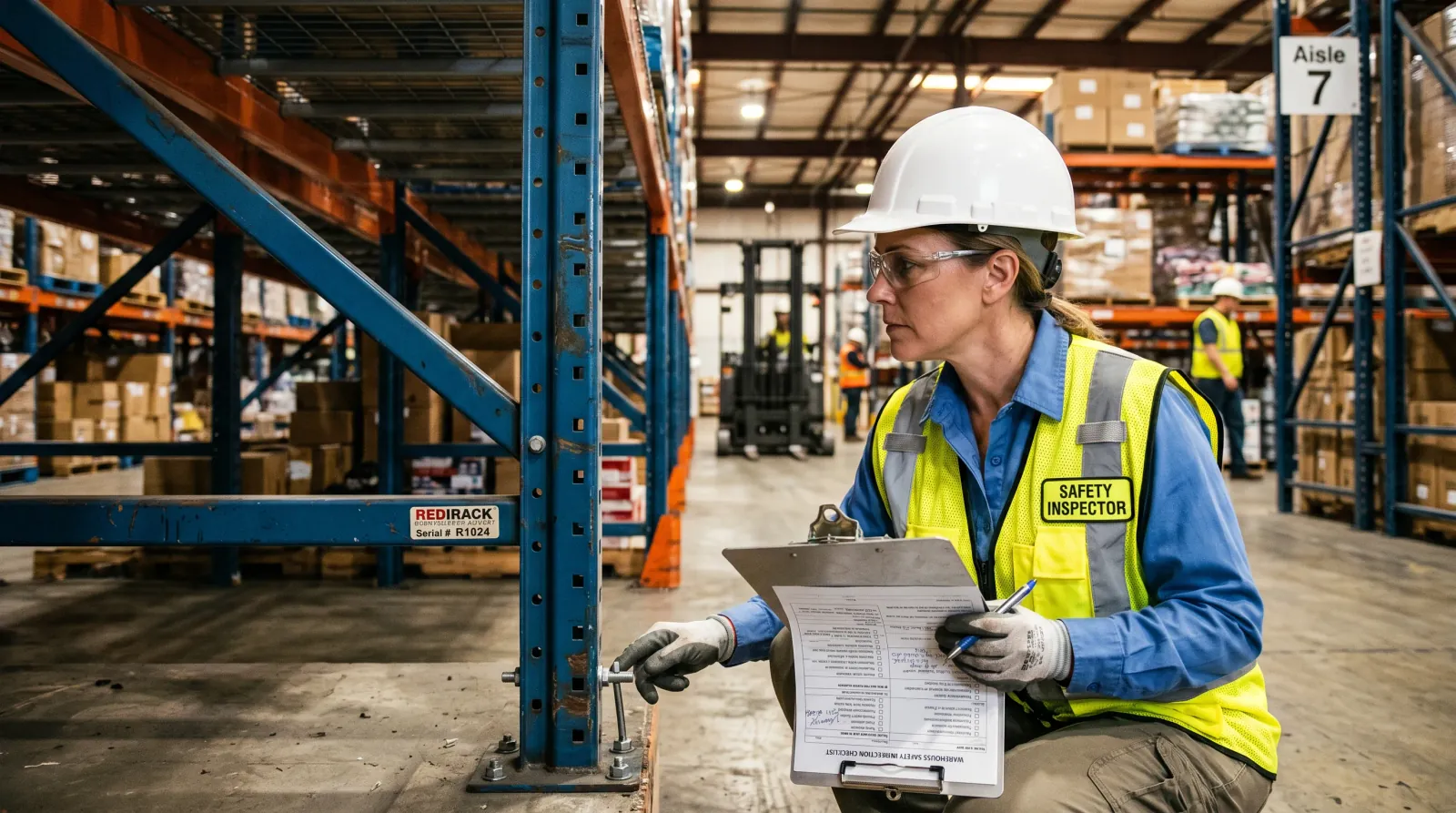
Critical Safety Note
Any rack section that has sustained damage must be taken out of service — offloaded completely — before assessment. Do not attempt to assess damage with product on the affected section. Indy Pallet Racking provides emergency rack damage assessment throughout Indianapolis and Central Indiana.
The First Step: Take It Out of Service Immediately
Before any repair-versus-replace analysis happens, the damaged rack section must be taken out of service. This is not a judgment call — it is required by OSHA and ANSI/RMI, and it's the only safe course of action. "Out of service" means:
- All product removed from the affected bay and adjacent bays if there is any risk of cascade failure
- Physical barriers (safety tape, barriers, locked-out access) preventing anyone from loading the section
- A visible "Do Not Use" tag or sign on the damaged component
- Notification to warehouse management and documentation of the incident date and time
Continuing to operate damaged rack — even for a few shifts while waiting for a repair crew — is both an OSHA violation and an unacceptable safety risk. A bent upright can lose 40–80% of its rated capacity. What appears to be minor cosmetic damage may represent a structural failure point under load.
ANSI/RMI Damage Classifications
The Rack Manufacturers Institute ANSI/MH16.1 standard provides a framework for classifying rack damage that guides the repair-versus-replace decision. While the standard uses technical engineering thresholds, the practical classification system most rack safety professionals use breaks damage into three levels:
Minor Damage — Monitor or Replace Component
Small dents, minor paint scraping with no deformation of the steel, slightly damaged column guards with no impact transferred to the upright. These are typically cosmetic and do not require immediate structural action — but should be documented, monitored, and scheduled for correction during the next maintenance window.
Moderate Damage — Requires Professional Assessment
Visible deformation of column steel (bowing, kinking, twisting), damaged welds at beam connections, bent bracing members, or missing safety clips. The section must be taken out of service and assessed by a qualified inspector before any decision on repair versus replacement. Some moderate damage can be repaired with certified replacement components; other damage requires full upright replacement.
Severe Damage — Replace
Significant column buckling or permanent deformation, cracked welds, twisted or collapsed upright frames, or any damage that has altered the geometry of the rack structure. Severe damage requires replacement of the affected components — there is no safe repair option for a structurally compromised upright column or frame.
The critical rule: rack uprights must never be field-welded, cut, or modified as a repair method. Field welding alters the structural properties of the steel and voids the manufacturer's certification. Any upright that requires more than replacement of undamaged components must be replaced entirely.
What Can Actually Be Repaired vs. What Must Be Replaced
Understanding what is repairable and what isn't prevents both over-spending on unnecessary replacement and dangerous under-response to structural damage:
Repairable (Component Replacement)
- Damaged or missing beam safety clips — replaced with manufacturer-spec hardware
- Bent or damaged beams — replaced with identical-spec beams from the same manufacturer
- Damaged column guards or end-of-aisle protectors — replaced without structural implications
- Missing or damaged row spacers — replaced with correct hardware
- Damaged pallet supports or wire decking — replaced with matching components
Requires Upright Replacement
- Any visible deformation (bowing, kinking, twisting) of upright column steel — even minor deformation beyond ANSI/RMI tolerance limits
- Cracked or failed welds in the upright frame
- Damaged base plates that cannot be replaced independently (most base plates are welded to the column)
- Any upright that has been previously repaired by field welding
- Uprights with visible deformation at the column perforation pattern (the holes that accept beam connectors)
Repair Products: Column Repair Kits
A legitimate product category exists called column repair kits — steel sleeves that bolt around a damaged lower section of a column to restore structural capacity. These are a valid repair method when used correctly, but only when: (a) the kit is engineered and certified by a licensed PE for the specific damage and rack model, (b) the damage is within the kit's designed repair parameters, and (c) the installation is documented and load placards are updated to reflect any capacity changes. Column repair kits are not a substitute for engineering judgment, and they are not appropriate for severe structural damage.
The Cost Analysis: Repair vs. Replace
For Indianapolis warehouse operators weighing the financial side of the decision, here's a practical framework:
Repair Costs (Typical)
Beam replacement: $30–$80 per beam depending on size. Column repair kit: $200–$600 installed including engineering. Upright frame replacement: $400–$1,200+ depending on height and gauge. Inspection and documentation: $300–$600 for a professional written report.
Replacement Costs (Typical)
New upright frame (installed): $600–$2,000+ depending on height, gauge, and rack system. Full bay replacement with new components: $800–$3,000+ depending on configuration and number of beam levels.
For moderate damage where a repair is technically appropriate, repair cost is typically 30–50% of replacement cost. However, the decision should never be driven purely by cost — if the assessment indicates that replacement is the correct answer, the comparison becomes irrelevant from a safety and liability perspective.
Indiana Documentation Requirements After a Rack Incident
Documentation after a rack damage incident is not just good practice — it's necessary for OSHA compliance, insurance purposes, and liability protection. Indiana warehouse operators should document:
- Incident report: Date, time, location within warehouse, description of how the damage occurred, name of person who discovered or caused the damage, and immediate action taken (out-of-service tag, offloading)
- Photo documentation: Multiple photos of the damage from different angles before any repair work begins
- Professional inspection report: Written assessment from a qualified inspector identifying damage classification, recommended action, and any capacity restrictions pending repair
- Repair documentation: Description of repair performed, components replaced (manufacturer, model, spec), installer name and qualification, and date of repair
- Post-repair inspection: Confirmation that repaired section meets specification and is cleared for return to service, with updated load placard if applicable
If the incident involved an injury, OSHA reporting requirements apply in addition to the above documentation. Indiana OSHA (MOSH) requires reporting of fatalities within 8 hours and inpatient hospitalizations, amputations, or loss of an eye within 24 hours.
Preventing the Next Incident
Most pallet rack damage in Indianapolis warehouses is caused by forklift contact — and most forklift contact is preventable. The most effective preventive measures include:
- Column guards and end-of-aisle rack protectors on every vulnerable upright
- Adequate aisle widths for the equipment operating in them (see our aisle width guide)
- Clear aisle marking with floor paint or tape
- Forklift speed limits and traffic pattern enforcement
- Regular rack inspection with written reports — so minor damage is caught before it becomes moderate or severe
Indy Pallet Racking's Repair and Inspection Services
We provide professional rack inspection and repair services throughout Indianapolis and Central Indiana — including emergency response for acute damage incidents and scheduled annual inspections with OSHA-ready written reports. When replacement is warranted, our installation team handles new component installation with full documentation and load placard updates.
Call us at (317) 597-6252 for emergency rack damage assessment or to schedule a routine inspection for your Indianapolis area facility.
Rack Damage in Your Indianapolis Warehouse?
We provide professional damage assessment, repair, and replacement services throughout Indianapolis and Central Indiana. Same-week scheduling — emergency response available.
Request an AssessmentReady to Optimize Your Warehouse?
Get a free estimate from Indianapolis's warehouse racking experts. We serve warehouses of all sizes throughout the Indianapolis, IN metro area.